
Reflection on Guest Lecture With Jeff Hopkins
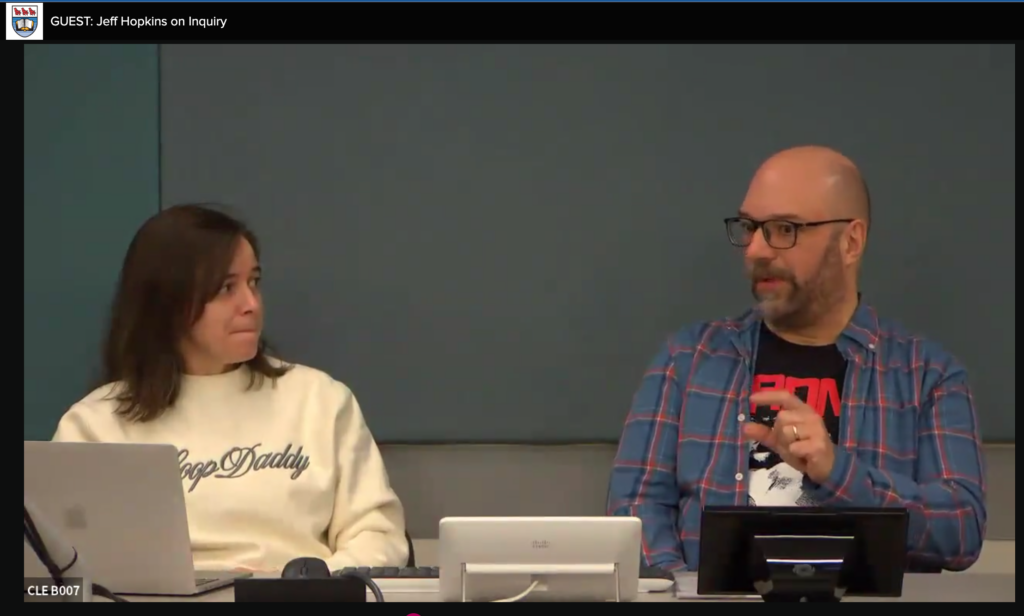
This week I am reflecting on Jeff Hopkins’ guest lecture. Hopkins shared a detailed presentation on inquiry-based learning specific to the Pacific School of Innovation. Hopkins shared that inquiry-based learning offers flexibility, and meaning for students, and provides a foundation for students to be personally involved and connected to their learning. A poignant point is when Hopkins mentioned that to get students thinking he asks:
What are you curious about? What have you wondered about? What has you know, kind of been bothering you or exciting you, or whatever it might be. Then you always have the next tier of people that say nothing or nothing that comes to mind, or they’re embarrassed about the thing they’re interested in, because they’re not sure if it’s deep enough, if it is serious enough.
(Hopkins, 2025)
The lecture reminds us of the importance of applying inquiry-based learning in different fields of study. For example, sociology, a degree based on examining the shortcomings in society and learning about how to address social problems, leaves many students with no tangible tools to engage with the real world because we are not taught to engage with movements that are meaningful to us. I conducted a qualitative research study last semester investigating the question: How do sociology students’ values and confidence in their abilities influence their involvement in global liberation movements particularly involving Palestine and the Democratic Republic of the Congo, on campus and within the broader community of Victoria? The results from the study revealed an alarming discrepancy. Sociology students at UVic do not feel prepared to intentionally engage with social movements around them, and one solution could be the integration of inquiry-based learning.
Applying sociological learning beyond the classroom is a way to set students with tools to take learning further. Atkinson & Hunt (2018) define inquiry-guided learning (IGL) as a diverse set of teaching methods aimed to inspire students to actively investigate sociological questions and problems in the world around them. Inquiry-guided learning involves students thinking and acting like sociologists through the engagement in active investigation and knowledge construction rather than mere memorization and is key in teaching students to “do” sociology rather than engage passively (Atkinson & Hunt, 2008). It is a pursuit to encourage students to become informed citizens and effective problem solvers within society (Atkinson & Hunt, 2008). Atkinson & Hunt (2018) state that this can be enforced in classrooms by introducing students to data analysis using both quantitative and qualitative data, engaging in complex activities that require synthesis, and “problematizing text” by using class textbooks.
Inquiry-guided learning is an intentional approach to teaching that inspires students to develop a deeper understanding of the social forces that shape their lives through the sheer application of their sociological knowledge (Atkinson & Hunt, 2008); It is the merging of knowledge and a conscious effort by students to add meaning to what they are studying. As Hopkins mentioned, teaching methods influence student’s learning experiences. These teaching methods influence sociology students’ involvement in social justice activism. This is an idea that can merge the gap between classroom learning and societal impact for sociology students.
References
Atkinson, M. P., & Hunt, A. N. (2008). Inquiry-Guided Learning in Sociology. Teaching Sociology, 36(1), 1-7. https://doi.org/10.1177/0092055X0803600101